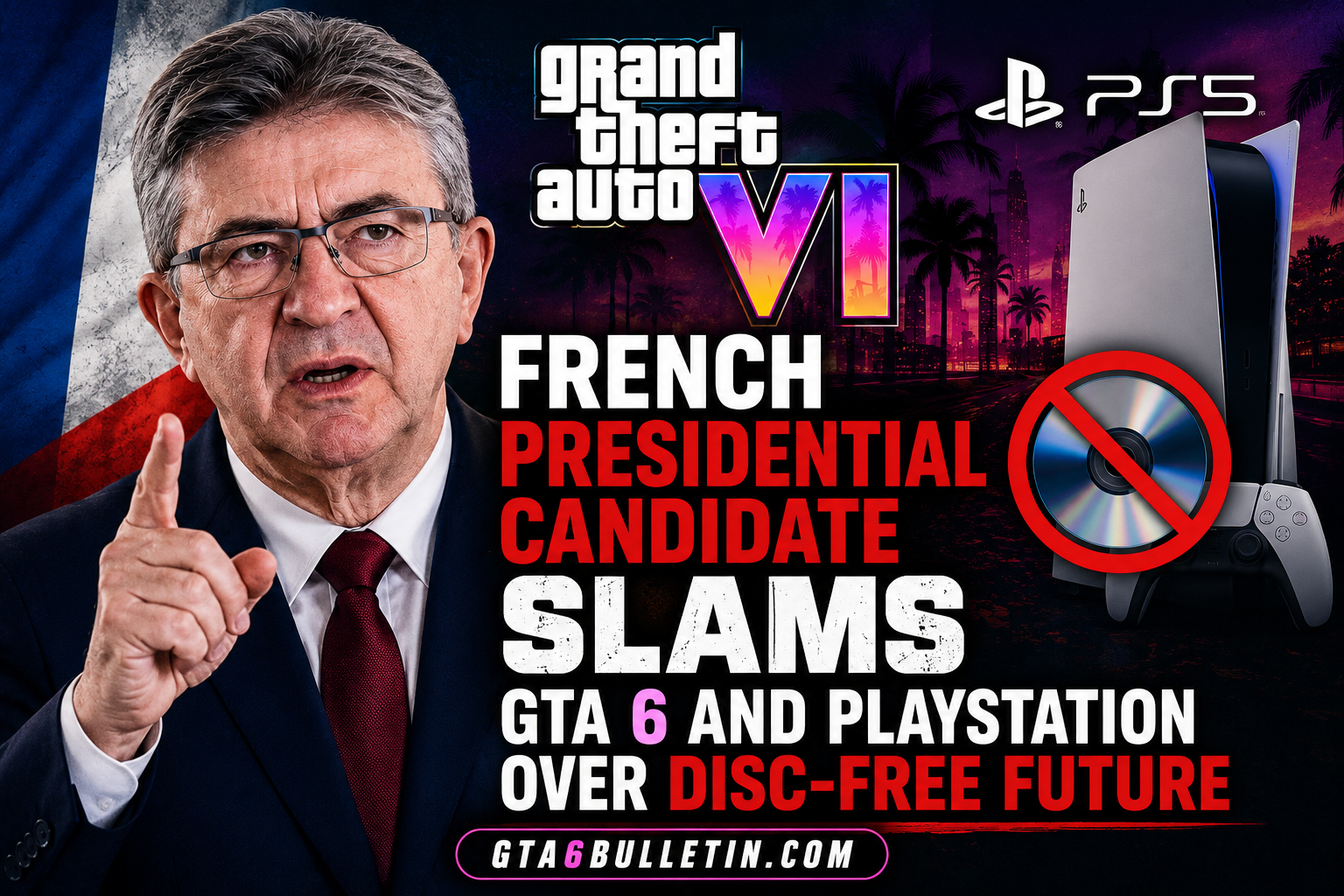
French Presidential Candidate Slams GTA 6 and PlayStation Over Disc-Free Future
The fallout from Grand Theft Auto 6 shipping without a physical disc has officially crossed over from gaming forums into national politics. A prominent French left-wing figure has now weighed in on the controversy, using it to make a broader case about consumer rights in an increasingly digital-only industry.
Jean-Luc Mélenchon, a longtime leader of France’s La France Insoumise party and a repeat presidential contender widely expected to run again in the 2027 election, took to social media to argue that gamers are losing something fundamental as publishers and platform holders move away from physical formats. His comments arrive at a particularly heated moment, just as Sony’s own plans to phase out PlayStation discs have reignited frustration across the gaming community.
While it remains to be seen whether this becomes an actual policy push or simply a timely talking point, the fact that a major political figure is engaging with the issue at all signals just how far the debate over digital ownership has spread.
What Did Mélenchon Actually Say?
In a post shared on X, Mélenchon directly referenced two recent flashpoints: Grand Theft Auto 6 launching without a disc on November 19, 2026, and Sony’s confirmed plan to end physical game disc production for PlayStation entirely starting January 2028. He used both examples to argue that gaming has reached a turning point where consumers are losing meaningful ownership over the products they pay for.
According to a translation of his statement, Mélenchon framed the shift toward all-digital distribution as a loss of basic consumer protections. His core argument: when there’s no physical copy, players are essentially renting access rather than owning anything outright, with no ability to resell, lend, or guarantee long-term access to what they’ve purchased.
He also stated that this issue would become part of a policy initiative he intends to pursue in 2027, positioning video games alongside films, books, and music as cultural products deserving of legal protection.
Key Points From Mélenchon’s Statement
- Games as cultural assets: He argues video games deserve the same protected status France already extends to film, literature, and music.
- No true ownership in digital-only models: Paying for a game without a disc, in his view, means paying for a license rather than a product.
- Loss of consumer rights: Without physical media, players lose the ability to resell, lend, or guarantee continued access to games they’ve bought.
- A future policy push: Mélenchon says he plans to formally address this issue as part of a 2027 legislative initiative tied to his political platform.
Why This Argument Resonates With Gamers
Mélenchon’s framing taps directly into concerns that have been building across the gaming community for years, but which intensified sharply following two recent developments:
- GTA 6’s digital-only launch, confirmed for November 19, 2026, which eliminated a traditional disc-based release for one of the most anticipated games in history. The boxed “physical edition” instead contains a download code.
- Sony’s official announcement, posted directly on the PlayStation Blog, that physical disc production for all new PlayStation games will end starting January 2028. Games already released or launching before that date are unaffected.
Digital purchases, unlike physical copies, typically only grant players a license to use the software. That license can theoretically be revoked, altered, or lost if a platform shuts down servers, changes policies, or goes out of business. For many players, that distinction is the heart of the issue: they’re not buying a game outright, they’re renting long-term access to one.
A French Cultural Tradition Meets Modern Gaming
Part of what makes Mélenchon’s comments notable is the legal and cultural context behind them. France has a long-standing tradition, often referred to as the “cultural exception,” of treating certain creative works like film, literature, and music as more than ordinary commercial products. These mediums receive special legal protections and public subsidies specifically because they’re considered valuable to national culture.
By invoking this tradition, Mélenchon is essentially proposing that video games be elevated to the same protected category. It’s a distinctly different angle than most of the consumer backlash seen online, which has largely focused on convenience, resale value, and preservation concerns rather than cultural policy.
Could This Actually Change Anything?
This is where speculation becomes important to separate from fact.
Confirmed:
- Mélenchon made these statements publicly on X.
- GTA 6 is launching without a physical disc on November 19, 2026.
- Sony has officially confirmed, via its own PlayStation Blog, that it will end physical disc production for new PlayStation games starting January 2028.
- Mélenchon has stated he intends to raise this as a policy matter in 2027.
Speculative:
- Whether Mélenchon’s proposal would ever become actual law.
- Whether France or the European Union could realistically enforce ownership protections on global companies like Sony or Rockstar Games.
- Whether other politicians, in France or elsewhere, will pick up similar arguments.
Even with strong political backing, forcing multinational companies to reinstate physical formats or guarantee digital ownership rights would face significant legal complexity. French law would need to align with broader European Union regulations, and enforcement against companies headquartered outside the country would be far from straightforward. For now, there’s no indication that Rockstar Games or Sony are under any legal obligation to alter their plans.
The Bigger Picture
Mélenchon isn’t a fringe figure. He placed third in France’s 2022 presidential election, taking nearly 22 percent of the first-round vote, and he tends to poll strongly among younger voters, a demographic that overlaps heavily with the gaming audience. That level of influence means his comments carry more weight than typical online commentary, even if the immediate practical impact remains uncertain.
Whether this leads to genuine legislative action or simply serves as a way to connect with younger voters ahead of the 2027 election, one thing seems clear: the shift away from physical games has grown into a large enough cultural conversation that it’s no longer confined to gaming spaces alone.
Conclusion
The disappearance of physical game discs, first with GTA 6 and now more broadly with Sony’s PlayStation plans, has clearly struck a nerve far beyond the gaming community. Jean-Luc Mélenchon’s comments show that the conversation around digital ownership has expanded into mainstream political discourse, even if concrete policy change remains far from guaranteed.
For now, gamers concerned about losing ownership rights will have to watch and wait to see whether this becomes a genuine legislative effort or fades as just another political talking point. Either way, the debate over what it truly means to “own” a game isn’t going away anytime soon.
Frequently Asked Questions
About the Author